
Toward all-in-focus lensless imaging with full-aperture radial masks
Optics Express 2025
Abstract
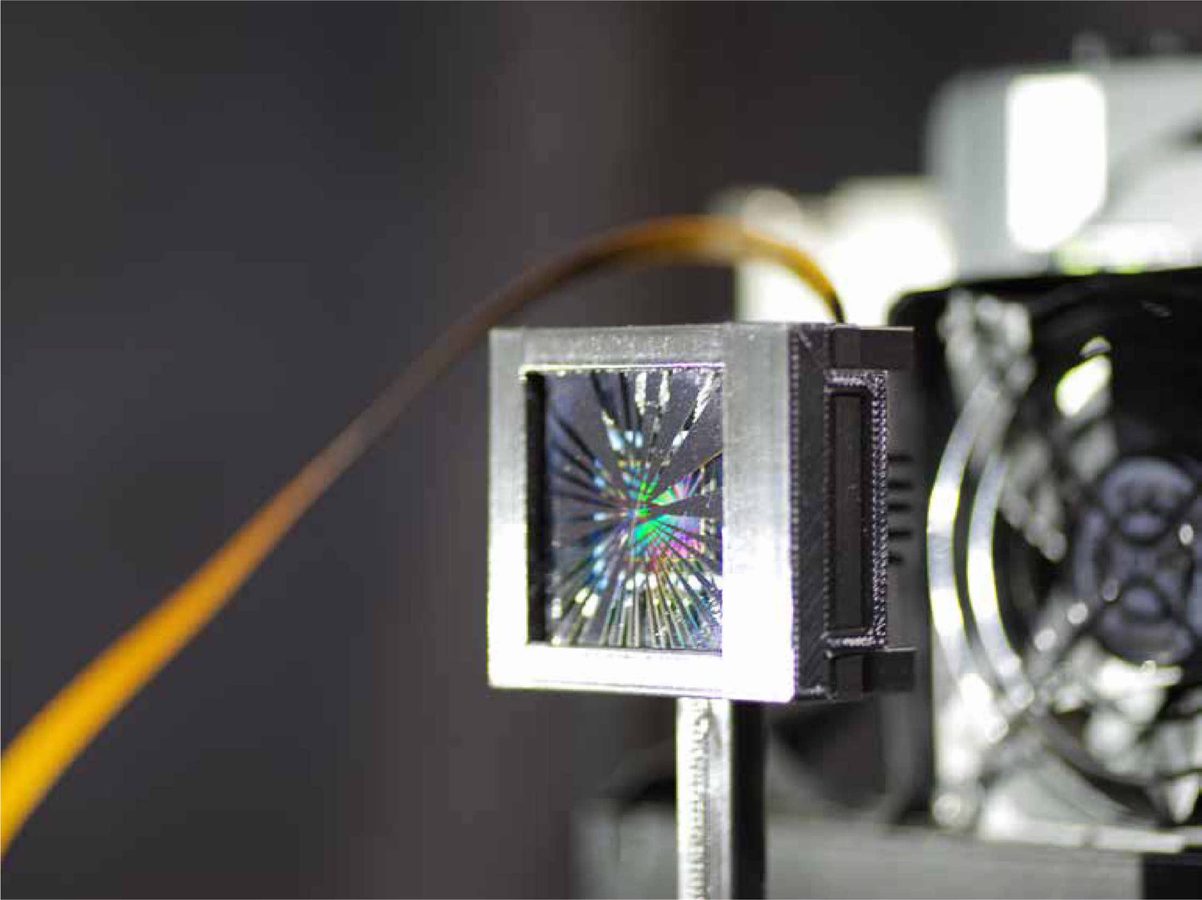
Lensless imaging, which combines coded apertures with computational reconstruction, has emerged as a promising approach for realizing ultra-thin cameras. In our prior work, we demonstrated that designing the aperture in a radial pattern can greatly extend the depth of field of lensless systems [1]. However, to maintain reconstruction stability, it was necessary to restrict the effective aperture area, which in turn limited the achievable depth-of-field range. In this study, we overcome this bottleneck by developing a new lensless optical system that employs a full-aperture radial mask, together with a reconstruction algorithm optimized for its characteristics. This enables imaging that is significantly closer to “all-in-focus” while maintaining a compact optical and computational design. Through numerical simulations and prototype experiments, we demonstrated the feasibility of an ultra-thin camera capable of capturing both near and far objects sharply at the same time. We also confirm its applicability to various tasks, including character recognition, QR-code reading, and imaging of natural objects.
[1] José Reinaldo Cunha Santos A. V. Silva Neto, Tomoya Nakamura, Yasushi Makihara, and Yasushi Yagi, “Extended Depth-of-Field Lensless Imaging using an Optimized Radial Mask,” IEEE Transactions on Computational Imaging, Vol. 9, pp. 857-868 (2023).
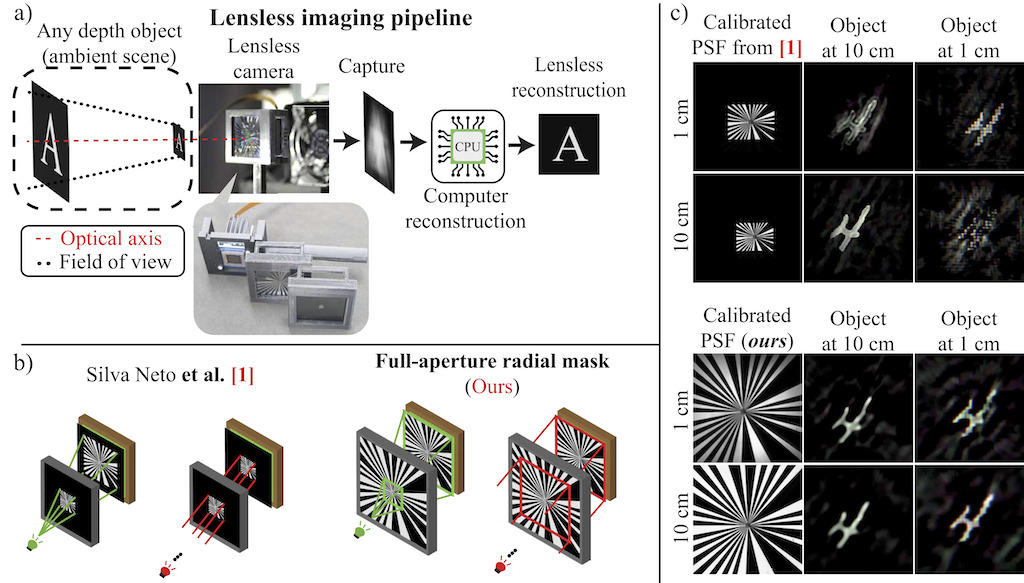
Overview of the all-in-focus lensless imaging with full-aperture radial masks
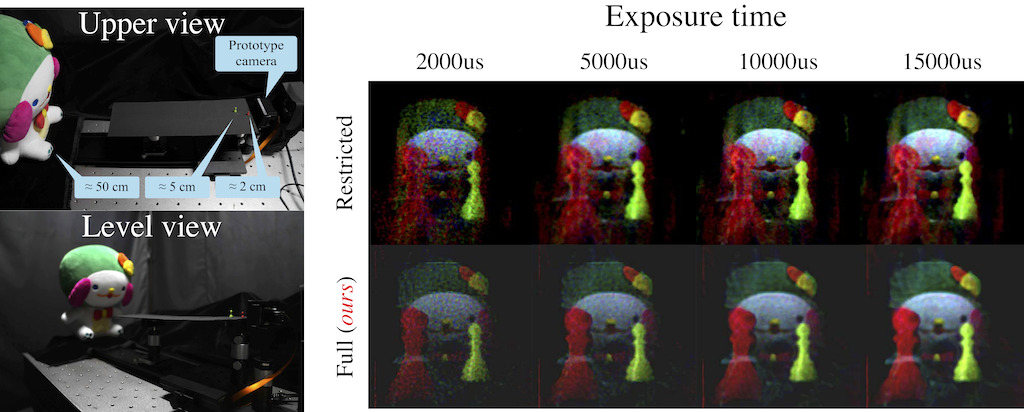
Imaging results for natural 3D scene and analysis of light-use efficiency
BibTeX
@article{silvaneto2025toward,
  author  = {Jos\'e Reinaldo Cunha Santos A. V. Silva Neto and Hodaka Kawachi and Yasushi Yagi and Tomoya Nakamura},
  title   = {Toward all-in-focus lensless imaging with full-aperture radial masks},
  journal = {Optics Express},
  volume  = {33},
  number  = {23},
  pages   = {48112--48129},
  year    = {2025}
}